
Highlights
The initial development or acquisition budget accounts for less than 30% of lifetime AI medical scribe infrastructure costs.
Clinical AI stability relies on consistent downstream engineering, continuous prompt maintenance, and robust clinical quality assurance.
Healthcare executive leadership must calculate total cost of ownership beyond SaaS licenses or initial model training to ensure long-term clinical safety and operational viability.
What is the Total Cost of Ownership for AI Scribes?
According to the Journal of the American Medical Informatics Association (JAMIA), in its 2025 study "Development of Secure Infrastructure for Advancing Generative Artificial Intelligence Research in Healthcare," the true total cost of ownership encompasses all financial inputs required to sustain a machine learning model throughout its lifecycle. Initial deployment accounts for only part of the total cost, as healthcare organizations must also budget for ongoing infrastructure, API usage, technical support, monitoring, and maintenance.
When healthcare enterprise systems calculate the financial impact of deploying generative artificial intelligence at the point of care, they frequently isolate the upfront procurement or build capital. For an ambient AI clinical documentation tool, these components fall into two distinct buckets: capital expenditure (CapEx) and operating expenditure (OpEx).
- CapEx (Initial Development and Setup): Software engineering hours for platform architecture, foundational fine-tuning of Large Language Models (LLMs), first-mile Electronic Health Record (EHR) integration projects, compliance documentation, and hardware/microphone deployment.
- OpEx (Recurring Lifecycle Maintenance): Ongoing API data pipeline maintenance, continuous prompt engineering adjustments, compliance drift auditing, clinical verification, and technical support.
Failing to estimate the hidden multi-year resource requirements often leads to project failure, system downtime, or possible inaccuracies in medical documentation.
Why the Initial Development Budget Accounts for Less Than 30% of Lifetime Costs
A 2025 study published in JAMA Network Open, “Evaluation of an Ambient Artificial Intelligence Documentation Platform for Clinicians,” illustrates that ambient AI implementation extends beyond the initial deployment stage. The researchers noted that implementation required real-time adjustments, license reassignment, clinician feedback, specialty-specific customization, and later full EHR integration. These findings suggest that health systems should plan for continued integration, customization, evaluation, and workflow support as ambient AI expands across the enterprise.
Initial development budgets capture only the baseline creation phase, overlooking the substantial operational overhead required to manage technical and clinical drift over time. The foundational software architecture accounts for less than 30% of total lifetime expenditures.
A common misconception is that clinical AI solutions function like legacy, static software installations. With legacy tools, once the initial codebase is deployed and integrated into an EHR via traditional HL7 or FHIR interfaces, the system requires minimal maintenance outside of standard server patches. Generative AI models operate under entirely different, non-deterministic paradigms.
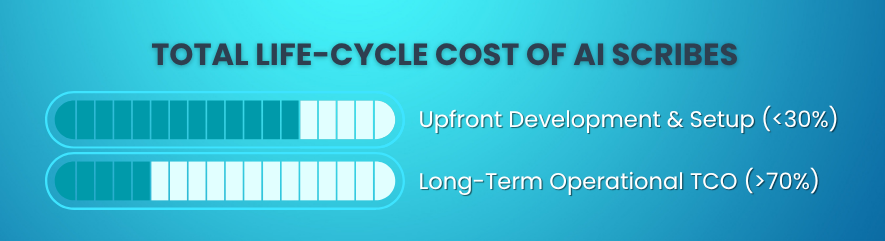
The majority of an AI tool's lifecycle expenses stem from unpredictable external changes. For example, commercial LLM vendors frequently update underlying model weights or deprecate specific API endpoints, causing sudden shifts in output structure. This requires immediate technical intervention. Furthermore, clinical documentation rules continually shift in response to updated medical practice guidelines or changes to institutional compliance metrics. When these components drift, the documentation output degrades instantly, proving that an enterprise cannot build a solution once and expect it to function autonomously in perpetuum.
Quantifying the Recurring Expenses of Specialized AI Personnel
Kaiser Permanente’s 2025 report, “Quality Assurance Informs Large-Scale Use of Ambient AI Clinical Documentation,” shows that sustaining ambient AI documentation at scale requires coordinated support from a highly technical, interdisciplinary team dedicated entirely to post-deployment infrastructure, linguistic optimization, and quality assurance. Their responsibilities extend beyond deployment to include ongoing performance monitoring, documentation-quality review, specialty-specific workflow adaptation, user feedback, and system improvement.
Sustaining a reliable ambient AI documentation infrastructure requires a highly technical, interdisciplinary team dedicated entirely to post-deployment infrastructure, linguistic optimization, and quality assurance (QA) auditing. These roles demand significant recurring salary outlays.
| Professional Role | Core Operational Mandate | Estimated Average Annual Base Salary (USD) |
| Senior AI Infrastructure Engineer | CI/CD pipelines, cloud scalability, ASR/LLM orchestration, EHR write-back | $160,000 – $210,000 |
| Prompt Maintenance Specialist | Prompt optimization, semantic routing, version control, specialty tuning | $110,000 – $145,000 |
| Clinical QA Auditor | Hallucination auditing, medical narrative validation, regulatory compliance | $85,000 – $115,000 |
1. Senior AI Infrastructure Engineers
An ambient AI scribe platform handles massive pipelines of unstructured telemetry data—specifically, raw multi-speaker ambient audio recordings—that must be captured, encrypted, transmitted, and transcribed in near real time. Senior AI infrastructure engineers manage the continuous integration and continuous deployment (CI/CD) pipelines that connect the audio capture front-end to advanced automatic speech recognition (ASR) engines and LLM reasoning steps. These specialists monitor processing latencies, prevent API failures, manage cloud compute infrastructure scaling, and maintain the complex write-back pipelines that insert finished text directly into discrete EHR fields.
2. Prompt Maintenance and Tuning Specialists
Because generative language models are inherently non-deterministic, small changes in user input, accent, or ambient noise can alter downstream outputs. Prompt maintenance specialists focus on iterative prompt optimization, semantic routing, and context management. When clinicians report that an AI tool is suddenly omitting specific objective findings, misinterpreting physical exam structures, or applying the wrong medical note format, these professionals rewrite, test, and version-control system prompts to stabilize output performance across diverse medical disciplines.
3. Clinical Quality Assurance (QA) Auditors
The ultimate safeguard against automated misinformation is clinical oversight. Clinical QA auditors—typically experienced nurse informaticists or trained medical transcription quality analysts—systematically pull sample recordings and cross-reference them against the AI-generated SOAP notes, H&Ps, or progress reports. They score notes for systemic errors such as clinical hallucinations, incorrect medication dosages, omissions of critical negative findings, and non-compliance with billing guidelines. This clinical feedback loop directly informs prompt engineering and model fine-tuning processes.
How Does an Enterprise Build vs. Buy Strategy Impact Long-Term TCO?
An enterprise "Buy" strategy shifts responsibility to a specialized software vendor, dramatically reducing internal technical overhead compared with building a proprietary solution from scratch. Third-party vendors absorb the costs of massive engineering, maintenance, and clinical QA teams.
When evaluating the market landscape, large healthcare networks frequently compare industry-leading options. Understanding where specific vendors sit within the broader ecosystem helps clarify any confusion regarding resource allocation.
- Enterprise Health-System Solutions: These platforms deliver deep, enterprise-wide EHR integrations (particularly within Epic and Cerner ecosystems). They command premium per-provider monthly fees that cover their extensive internal engineering and cloud hosting infrastructure.
- Specialty-Specific Platforms: Heavily tailored to complex, highly specific workflows, such as rehabilitation therapy. They utilize highly customized underlying models but carry premium quote-based pricingto offset the cost of hyper-specialized QA and clinical training datasets.
- Flexible, Discipline-Agnostic Infrastructure: Platforms like ScribePT bypass the rigid, expensive deployment paradigms of traditional monolithic systems. By focusing on flexible API delivery and fully white-labeled software options, ScribePT allows organizations to achieve deep specialty optimization without building an entire technical stack from scratch, mitigating the internal headcount costs associated with native AI development.
Best Practices for Managing and Optimizing AI Scribe Costs
To successfully manage a scaling deployment without letting recurring costs overtake initial ROI projections, enterprise healthcare organizations should adopt the following operational strategies:
- Implement Automated Regression Testing for Prompts: Instead of relying exclusively on manual reviews to test prompt updates, use automated LLM-as-a-judge frameworks to evaluate modifications against a standardized library of historical clinical encounters. This surfaces regression issues before they reach production.
- Establish a Tiered QA Sampling Matrix: Auditing 100% of notes is financially non-viable. Deploy a risk-stratified sampling model where new clinicians or complex multi-specialty cases are audited heavily (e.g., 10% of notes), while seasoned users using stable documentation formats are sampled at a lower interval (e.g., 1% of notes) to minimize auditor overhead.
- Utilize Pre-Configured, Specialty-Aware Integration Layers: Avoid building highly custom, one-off integration frameworks for every separate department. Rely on configurable, discipline-agnostic middleware platforms that can adjust templates and handle terminology variations procedurally, rather than requiring dedicated engineering code changes for each unique clinic workflow.
Turning TCO Into ROI: ScribePT as Your Strategic Integration Infrastructure
ScribePT provides healthcare organizations and EMR vendors with highly secure, fully managed AI integration infrastructure that completely eliminates the need to build, maintain, and audit an internal AI stack.
Rather than taking on the massive financial burden of recruiting senior AI infrastructure engineers, dedicated prompt tuners, and large clinical QA auditing teams, organizations can deploy ScribePT's market-proven ambient scribing technology via robust, easy-to-use APIs or a fully white-labeled platform partnership. ScribePT handles the complex backend lifecycles natively:
- Proven Data Security: ScribePT eliminates compliance risks by maintaining a highly secure infrastructure, backed by a successful SOC 2® Type II certification audited and attested by Prescient Security. This ensures clinical data is fully safeguarded within a trusted, real-world deployment environment.
- Specialty Fit and Accuracy: Built with deep, complex specialty language at its core—yet engineered to be discipline-agnostic—ScribePT delivers notes out of the box, reducing the manual refinement effort that causes clinician fatigue and drops system engagement.
- Rapid Time-to-Market: EMR systems and clinical groups can skip lengthy, multi-year internal development lifecycles and heavy engineering lifts. ScribePT allows partners to deploy AI-driven charting capabilities within their existing platform architectures in just weeks, not months.
By embedding ScribePT's scalable infrastructure, healthcare networks protect their software roadmaps, eliminate up to 70% of lifecycle costs associated with building proprietary clinical models, and unlock immediate, compliant operational growth.