
Highlights
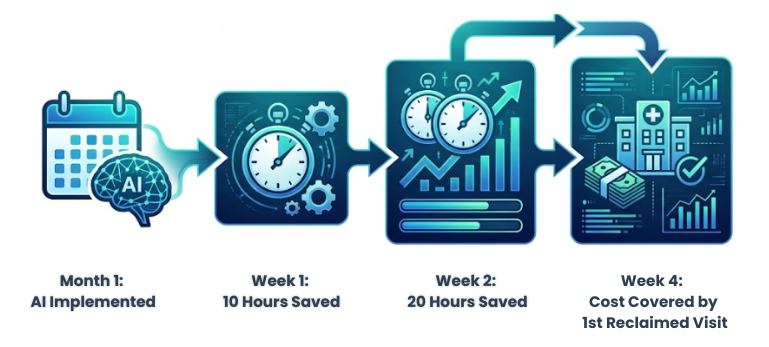
Clinicians eliminate up to 90% of manual documentation time immediately upon deployment, recovering 30 to 40 hours per month.
With ScribePT’s straightforward pricing model, reclaiming just two hours of clinical labor per provider per month completely offsets the software cost.
Reclaiming hours previously spent typing, clicking, and templating allows rehab therapy and medical practices to safely add 1 to 2 patient encounters per clinician per day without lengthening the workday.
What is the Time-to-Value of Ambient AI Scribing?
Direct Answer: The Time-to-Value (TTV) of an ambient AI scribe is virtually instantaneous, with operational relief achieved within the first 48 hours of deployment and complete financial payback realized within the first 30-day billing cycle as clinicians reclaim up to 90% of their manual charting hours.
Unlike legacy enterprise systems that demand months of expensive configuration, custom software development, or extensive EMR re-templating, modern AI solutions for clinics and practices function as a frictionless overlay. For practice managers, clinic owners, and healthcare administrators, the value of this technology unfolds across two distinct operational timelines:
- Immediate Operational Value (Days 1–5): The immediate reduction of documentation-related administrative burdens. Clinicians stop taking charts home at night ("pajama time"), which is widely cited in the American Medical Association (AMA) as a primary driver of healthcare provider burnout.
- Hard Financial Value (Days 15–30): The point at which the reclaimed clinical hours or added patient appointments generate enough revenue or overhead savings to fully cover the software's monthly subscription fee.
How Do You Calculate the Return on Investment of an AI Scribe?
Direct Answer: To calculate the return on investment (ROI) of a clinical AI scribe, a practice must weigh the subscription cost against the value of reclaimed clinical hours, either by multiplying the clinician's hourly rate or by the net revenue generated from using those open slots for additional patient visits.
To measure this accurately, financial administrators must analyze the direct trade-off between administrative overhead and clinical throughput. Traditional documentation methodologies rely on manual keyboard entry, template clicking, and dictation playback, consuming up to 35% of a clinician’s average workday.
The Documentation Cost Formula
To determine how much a practice currently spends on manual charting, use the following equation:

When an ambient AI tool is introduced, manual documentation time typically drops by 80% to 90%. For example, if a physical therapist earning an average of $45 per hour spends 30 hours per month typing SOAP notes, the practice's baseline charting overhead is $1,350 per month per therapist.
Reinvesting Reclaimed Hours
When an AI scribe reduces those 30 hours down to just 3 hours of quick validation, the practice recovers 27 hours of clinical capacity. This reclaimed time can be leveraged in two ways:
- Revenue-Generating Pathway: If the therapist uses just 10 of those 27 reclaimed hours to schedule additional patient visits, at a standard Medicare reimbursement rate of $100 per visit, the clinic generates $1,000 in monthly revenue per clinician.
- Burnout-Mitigation Pathway: In organizations operating at full capacity, returning those 27 hours to the clinician preserves work-life balance. According to a study on clinician burnout published in the National Academy of Medicine (NAM) Perspectives, replacing a single clinician who left, which can be due to administrative fatigue, can cost a practice an increasing amount of $100,000 to $250,000 in recruitment, credentialing, and temporary coverage. This means that preventing even one resignation yields a massive indirect ROI.
How Does Ambient AI Compare to Traditional Documentation Methods?
Direct Answer: Ambient AI scribes deliver faster turnaround times and significantly lower monthly overhead than traditional human medical scribes or manual dictation services, reducing documentation costs by up to 90% while maintaining compliance.
Historically, healthcare organizations relied on human scribes or dictation services to offload clinical notes. The table below outlines how modern ambient AI documentation compares to legacy options on key financial and operational metrics.
| Metric | ScribePT Ambient AI | Dedicated Human Scribes | Legacy Dictation Services |
| Average Monthly Cost | $75 (annual rate) | $2,500 – $3,500 | $400 – $800 |
| Note Turnaround Time | Instantly (seconds after visit) | Real-time during visit | 12 to 24 hours |
| Onboarding & Training | Under 2 hours | 2 to 4 weeks | Ongoing template setup |
| Security & Compliance | SOC 2 Type II, ISO 27001, HIPAA | Variable; human error risk | Variable transmission security |
| Workflow Integration | Chrome Extension / EMR APIs | Manual EMR entry | Manual copy-paste or upload |
By eliminating human management overhead, training cycles, and scheduling conflicts, ambient AI scribe solutions like ScribePT are a more secure, scalable, and cost-effective alternative.
What Variables Determine the Break-Even Point for a Practice?
Direct Answer: The break-even point for implementing an AI scribe depends on four variables: the software subscription fee, the clinician's hourly cost, the clinic's average reimbursement per visit, and the AI's accuracy in capturing discipline-specific language.
For a standard medical or rehabilitation clinic, the math behind the break-even timeline is remarkably straightforward:
At ScribePT, we believe in complete transparency of our product offerings and prices—which is why we charge no hidden fees and don't use any complicated pricing structures. ScribePT offers a flat subscription rate of $75 per month when billed annually (with $0 setup fees and unlimited audio recording).
- Under an Overhead-Reduction Model: At a clinician cost of $45/hour, the tool pays for itself once the clinician saves 1.6 hours of documentation time in a given month. Since most clinicians save this much time on their first day of use, the tool is net-positive within 24 to 48 hours.
- Under a Revenue-Generation Model: If the clinic's average reimbursement per visit is $100, the clinician only needs to see one additional patient per month using their reclaimed hours to completely cover the software subscription.
The speed at which this break-even point is reached depends heavily on clinical adoption. If an AI tool struggles with specialty-specific terminology—such as physical therapy functional progress measures, range of motion (ROM) values, or occupational therapy goals—the clinician will spend an excessive amount of time editing the draft notes. This "edit tax" degrades the time-saving benefit, delaying the break-even point.
Why Does Specialty-Specific AI Accelerate Payback for Rehab Therapy?
Direct Answer: Specialty-specific AI accelerates payback by eliminating "edit fatigue" through tailored clinical models that accurately capture complex rehabilitation terminology, functional goals, and SOAP structures on the first pass.
General-purpose AI models designed for primary care or general medicine often fail when deployed in specialized environments such as physical therapy (PT), occupational therapy (OT), or speech-language pathology (SLP). These general models frequently misinterpret specialized therapist phrasing or invent clinical data because they lack training in rehab-specific documentation structures.
How "Edit Fatigue" Affects Your Practice
When a therapist is forced to spend 5 to 10 minutes rewriting an AI's poorly drafted note, the time-saving benefits of the technology disappear. The number of inaccuracies leads to:
- Slower Adoption: Clinicians abandon the tool during the trial phase because it feels like double work.
- Compliance Risks: Poorly structured notes can lead to audit failures or claim denials, creating a negative financial impact.
- Delayed ROI: If note-taking still requires significant manual intervention, the clinic cannot scale its visit capacity or reclaim administrative hours.
This is why ScribePT was built from the ground up to understand specialized rehab therapy workflows. While our engine is discipline-agnostic and can easily support multiple specialties, ScribePT's deep, therapy-specific training ensures that complex physical, occupational, and speech therapy clinical concepts are captured accurately on the first draft. This high level of accuracy minimizes editing time, allowing clinicians to sign off on notes quickly and achieve a rapid payback period.
How Can You Safely Implement AI Scribes Without Security Risks?
Direct Answer: Safely implementing AI scribes requires partnering with vendors that maintain rigorous security certifications and compliance, such as SOC 2 Type II, ISO 27001, and HIPAA, to protect patient data.
When an AI scribe is not natively integrated into an EMR, clinicians desperate for documentation relief often resort to downloading unapproved third-party browser extensions or standalone applications. This practice introduces major security and compliance vulnerabilities, as sensitive protected health information (PHI) may be transmitted and stored outside of the organization's secure network perimeter.
To mitigate these compliance and security risks, healthcare organizations must partner with enterprise-grade AI solutions that secure patient data. ScribePT provides this level of security by having:
- SOC 2® Type II Certification: Audited and attested by Prescient Security, ensuring ScribePT's systems, policies, and operational controls meet rigorous trust standards for security, availability, and confidentiality.
- ISO 27001 Certification: Demonstrating an established, active Information Security Management System (ISMS) that systematically manages data security risks.
- Full HIPAA Compliance: Ensuring all clinical transcripts, patient data, and generated documentation are processed and encrypted to meet federal privacy regulations.
Seamless Integration Options
Rather than forcing clinicians to copy and paste sensitive information across unvetted interfaces, ScribePT offers flexible, secure deployment models that keep data protected:
- The ScribePT Chrome Extension: A lightweight, secure sidebar that works side-by-side with your existing EMR, enabling clinicians to record, generate, and import highly accurate SOAP notes with a single click.
- Robust APIs: Developer-ready integration endpoints that allow large healthcare organizations and EMR platforms to seamlessly embed specific ScribePT ambient AI capabilities directly into their native interfaces without disruptive development cycles.
- White-Label Solutions: A fully brandable, rapid go-to-market option for EMR vendors looking to offer a turnkey, clinical-grade AI experience under their own brand flag within weeks, bypassing years of internal R&D.
Estimate Your Payback Timeline
The financial and operational benefits of ambient AI documentation are clear, but every practice has unique operational variables. To see exactly how quickly an AI scribe can pay for itself in your specific clinical setting, use our interactive tool: ScribePT’s Interactive ROI Calculation Tool