
AI-powered documentation is quickly becoming a baseline expectation in healthcare technology. For EMR platforms, the question is no longer if AI should be integrated, but how to do it in a way that balances speed, risk, and long-term flexibility.
Many teams face difficult trade-offs. Build AI internally and risk long timelines, high costs, and uncertainty. Or integrate quickly, but worry about losing control over the product experience. The reality is, this doesn’t have to be an either-or decision.
This guide outlines a practical path forward. One that allows EMR platforms to introduce AI in weeks through white-label solutions, while still building toward deeper, fully embedded API integrations over time. Each section breaks down a key part of that journey, so you can move forward with clarity and confidence.
Start with the Foundation: Choosing the Right AI Partner
Before thinking about how AI will be embedded, the first decision is who you partner with. The right AI partner doesn’t just provide technology. They influence your time-to-market, your ability to scale, and how well the solution fits into your existing workflows.
EMR vendors need to evaluate partners based on more than features. Key considerations include healthcare-specific expertise, data security standards, implementation support, and the flexibility to support both short-term deployment and long-term integration strategies.
What to Evaluate in an AI Partner
| Criteria | What to Look For | Why It Matters |
|---|---|---|
| Healthcare Expertise | Experience with clinical workflows and documentation | Reduces onboarding friction and improves output relevance |
| Data Security & Compliance | HIPAA-ready infrastructure, secure data handling | Protects patient data and avoids compliance risks |
| Implementation Support | Hands-on onboarding and integration guidance | Speeds up deployment and reduces internal burden |
| Flexibility | Supports both white-label and API models | Prevents rework as your product evolves |
Quick Checklist Before You Decide
- Can they get you live in weeks, not months?
- Do they support both short-term and long-term integration paths?
- Are they built specifically for healthcare use cases?
- Can your team rely on them post-launch?
Choosing the wrong partner can lead to rework, delays, and added complexity later. Choosing the right one sets the foundation for a smoother rollout and future expansion.
👉 Learn how to evaluate and choose the right AI integration partner: Click Here

Move Fast First: Launching AI with White-Label Integration
For EMR platforms looking to move quickly, white-label AI offers the fastest path to getting AI into users’ hands. Instead of building from scratch, you can deploy a fully functional AI solution under your own brand, often within weeks.
This approach allows you to immediately introduce AI-powered documentation without heavy development effort. It also reduces the burden on engineering teams while still delivering value to end users.
White-label integration is especially useful for testing adoption, gathering feedback, and strengthening your product offering early. It gives you a working solution today, while keeping the door open for deeper customization later.
White-label isn’t a shortcut. It’s a strategic first step that gets your product moving while you plan what comes next.
White-Label vs. Building from Scratch
| Approach | Timeline | Engineering Effort | Risk Level |
|---|---|---|---|
| White-Label | Weeks | Low | Low |
| Build In-House | Months to Years | High | High |
👉 Explore how white-label AI integration works and when it makes sense: Click Here

Integrate Deeper Over Time: Transitioning to API Integration
After establishing early momentum with white-label, the next step is deeper integration through APIs. This is where AI becomes more embedded into your platform’s core experience.
What Changes with API Integration
- AI becomes embedded into your core workflows
- You control how and where AI appears in the UI
- You can customize outputs and user experiences
- You align AI tightly with your product roadmap
Best Practice for Transitioning
- Start with white-label to validate usage
- Identify where deeper integration adds value
- Gradually replace or enhance features with APIs
- Avoid rebuilding everything at once
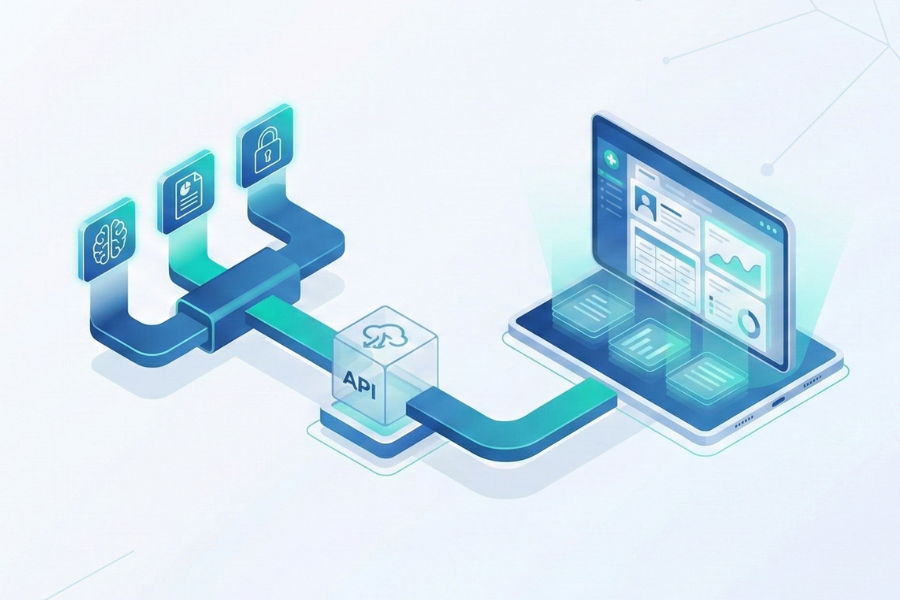
API integration isn’t the starting point. It’s the next layer once you have traction. It gives you greater control over workflows, UI, and how AI interacts with your system. Embedding APIs in your platform allows you to tailor the experience to your users while scaling functionality over time.
👉 Learn the benefits and best practices of API integration for EMRs: Click Here
Reduce Friction Along the Way: Managing Development Risks
One of the biggest concerns with AI integration is risk. Whether it’s data security, performance reliability, or unexpected development challenges, these risks can slow down progress or impact product quality.
Using proven AI infrastructure helps reduce uncertainty. Instead of building everything from the ground up, EMR vendors can rely on tested systems that are already designed for healthcare use cases.
Common Risks EMR Vendors Face
- Data security and compliance issues
- Unreliable or inconsistent AI outputs
- Integration delays due to technical complexity
- High dependency on internal engineering resources
How to Reduce These Risks
- Use proven, healthcare-ready AI infrastructure
- Avoid building core AI systems from scratch
- Choose partners with established deployment models
- Validate performance early before scaling
This approach not only improves stability but also allows teams to focus on product experience rather than back-end complexity. It’s a practical way to move forward with confidence while avoiding common pitfalls.
👉 See how to reduce development risks with proven AI infrastructure: Click Here

Plan for the Long Term: Understanding the True Cost of AI
Building AI internally often appears attractive at first, but the full cost is rarely obvious upfront. Beyond initial development, there are ongoing expenses related to maintenance, model updates, compliance, and scaling.
These hidden costs can add up quickly, especially for teams without dedicated AI expertise. In many cases, what starts as a cost-saving initiative turns into a long-term resource drain.
Cost Breakdown: Build vs. Integrate
| Cost Area | Build Internally | Integrate (White-Label/API) |
|---|---|---|
| Initial Development | High | Low |
| Time to Market | Slow | Fast |
| Ongoing Maintenance | High | Shared/Lower |
| Scalability Costs | Internal burden | Managed externally |
Strategic Insight
A phased approach allows you to:
- Control upfront investment
- Reduce long-term financial risk
- Scale AI based on real usage, not assumptions
A phased approach helps control costs while still allowing you to scale. It ensures you’re investing strategically rather than committing significant resources upfront. Understanding cost early helps avoid expensive pivots later.
👉 Break down the real costs of building AI documentation for EMRs: Click Here

The Smart Path Forward—Start with White-Label, Scale with APIs
The most effective approach to embedding AI in EMRs is not about choosing between speed and control. It’s about sequencing both in a way that supports immediate impact and long-term growth.
Starting with a white-label solution allows EMR platforms to launch quickly, deliver immediate value to users, and begin learning from real-world usage. It removes the pressure of building everything up front while still moving the product forward.
From there, API integration provides a natural next step. As your needs evolve, you can deepen the integration, customize workflows, and fully embed AI into your platform experience without having to start over.
This phased roadmap gives you the best of both worlds. Faster time to market today, with the flexibility to integrate a more tailored and scalable AI experience over time.